
How Can I Find Trustworthy Reviews for Period and Fertility Tracking Apps?
The short answer: look for a review that discloses its own methodology, not just its conclusion. A trustworthy review of a period or fertility app tells you what it checked, medical accuracy, data privacy, how it treats users, and applies the same criteria to every app it covers. If a review can't tell you how it reached a star rating, the rating isn't worth much.
Period and fertility apps sit in a strange gap. The information inside them is some of the most sensitive data a person can generate, cycle history, pregnancy attempts, sometimes pregnancy loss, but the apps themselves are rarely reviewed with anything like the scrutiny a medical device would get. Most of what shows up in a search is either an app-store star rating or an SEO-optimised "top 10" listicle, and neither is actually checking what matters.

Why fertility and period app reviews need more scrutiny than most
Two things make this category different from an average app review.
The data is unusually sensitive. A fertility or period app can reveal pregnancy attempts, pregnancy status, and reproductive health history, information with real consequences if it ends up somewhere it shouldn't, from insurers to advertisers to, in some jurisdictions, legal exposure. A generic productivity app leaking data is inconvenient. A fertility app doing the same is a different category of risk entirely.
The medical claims are easy to get wrong. Fertility prediction, ovulation windows, hormone-free contraception claims, these rest on real reproductive science, and apps vary hugely in how rigorously they've validated their methods. A review that only covers "ease of use" tells you nothing about whether the app's core predictions are clinically sound.
What actually makes a review trustworthy
A handful of signals separate a genuinely independent review from marketing dressed up as one.
The same criteria, applied to every app. If a review site can't tell you what it checks, or checks something different for each app, the ratings aren't comparable to each other
No pay-to-play. If an app (or its advertising budget) can influence its own score, the review isn't independent, regardless of how thorough it looks
Clinical involvement, not just a writer's opinion. Medical accuracy claims need a qualified person checking them, not just a content writer summarising the app's own marketing copy
Real user experience factored in, not just a technical policy read-through. How an app performs for actual women using it day to day is a different question from what its privacy policy says on paper
Reviewed on a schedule, not once and forgotten. Privacy policies and data-sharing practices change. A review from three years ago may no longer describe the current app
The red flags to watch for
Most of what ranks highly in a general search for "best period tracker" or "best fertility app" falls into one of two categories, and neither is independent:
Affiliate-driven listicles, where inclusion (and ranking) is tied to affiliate commission, not clinical merit, methodology is rarely disclosed because there often isn't one beyond "these apps have affiliate programmes"
App store ratings alone, which measure user satisfaction with the interface, not medical credibility or data handling, a beautifully designed app with weak privacy practices can still average 4.8 stars
Neither is dishonest exactly, but neither is answering the question "is this app safe and clinically sound," which is usually the actual question being asked.
Where to find reviews built specifically for this
SheRanked's directory includes dedicated categories for period trackers and fertility and IVF apps, reviewed against the same 74-question, doctor-designed framework used across the whole platform, so a fertility app and a period tracker are held to comparable standards, not reviewed on different terms.
A couple of examples already in the directory:
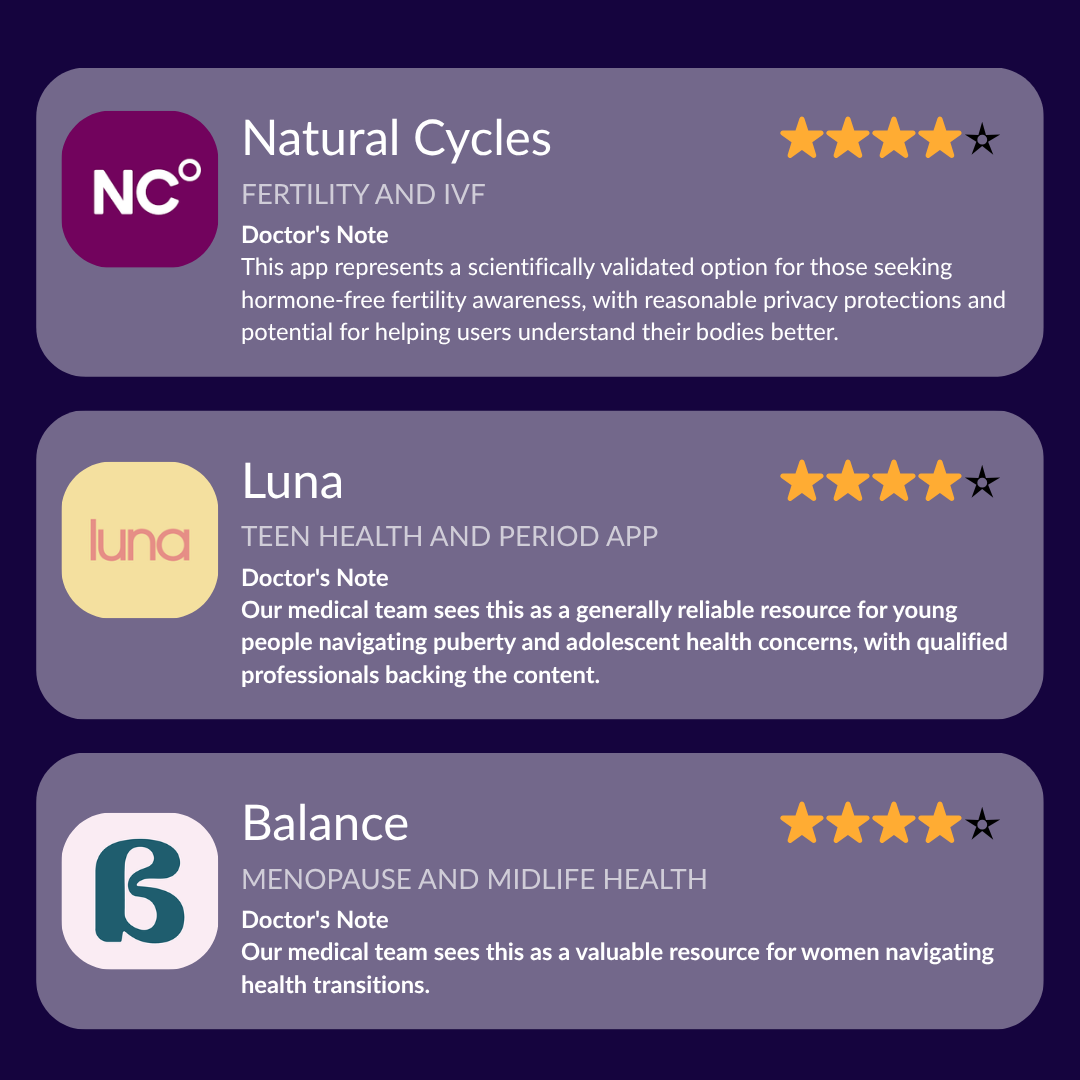
Natural Cycles carries a doctor's note describing it as a scientifically validated, hormone-free fertility awareness option, with reasonable privacy protections
Euki is noted as a solid choice for private, straightforward reproductive health tracking
Each listing includes a star rating out of five and a plain-language doctor's note explaining the reasoning, rather than just a number with no context.
What gets specifically checked for this category:
Whether fertility or ovulation predictions are backed by validated science, not just an algorithm's internal marketing claims
How pregnancy-related data, arguably the most sensitive data these apps hold, is stored, shared, and secured
Whether the app is honest about accuracy limitations (no fertility app can predict ovulation with certainty every cycle) rather than overselling precision
Accessibility and inclusivity of the app's language and design
Whether the app supports confident, informed decisions or creates anxiety and dependence on daily check-ins
Reading any review critically, in three questions
If you're checking a source that isn't SheRanked, three quick questions cut through most marketing dressed up as a review:
Does it explain how it reached the rating, or just state one?
Is the same methodology applied to every app it covers, or does coverage look inconsistent?
Is there any financial relationship (affiliate links, sponsorship) between the reviewer and the apps being reviewed, and is it disclosed?
Getting started
Search or browse the SheRanked directory by category to see period tracker and fertility app reviews directly, each with a star rating and a doctor's note. If you have a specific question about an app that isn't listed yet, Dr Christina Davies, an NHS and military doctor, answers reader questions directly, and the free monthly newsletter, The Download, covers new reviews and women's health tech essentials without the jargon.
FAQ
Are period tracker reviews on app stores trustworthy? They measure user satisfaction with the app's design and usability, not medical accuracy or data privacy. A high app-store rating and a high clinical/privacy score are answering different questions, and an app can have one without the other.
What's the difference between a "top 10 period apps" listicle and an independent review? A listicle is often ranked by affiliate relationships or SEO performance, with no disclosed methodology. An independent review applies a fixed set of criteria to every app and discloses how the score was reached.
Why does fertility app data privacy matter more than other health data? Fertility and pregnancy-related data can have real legal and personal consequences if it's shared or exposed, depending on where you live. It's treated as especially sensitive for that reason.
Does SheRanked update fertility app reviews over time? Yes, apps are re-reviewed annually so a rating reflects current data practices and app behaviour, not a one-time assessment.